
Visa’s latest Night-time Economy Index should give Hobart pause: the city ranks 46th nationally. Another measure, from the Council of Capital City Lord Mayors, places Hobart 24th among 88 local government areas for night-time economy turnover.
The methodologies differ, but both are useful reference points. They largely measure the City of Hobart, not Greater Hobart. Yet our 24-hour economy crosses council boundaries. Moonah, Glenorchy, Bellerive, Kingston and other centres shape how our community eats, meets, creates and spends time.
Rather than getting caught up in rankings, we should ask how Greater Hobart can build a better 24-hour economy that reflects who we are and the place we want to become.
Traditionally, nightlife has relied heavily on beverage sales. Pubs, clubs and licensed venues have carried much of the cost of providing live music, performance and social connection. That model has produced great venues and memories, but it is broken.
Venues, promoters and artists face rising costs and changing audience behaviour, while cost-of-living pressures make going out harder. The creative sector has never fully recovered from COVID, and the old model excludes younger people from many venues.
We have seen this through the Committee for Greater Hobart’s work with TUSA. Earlier this year, together we wrote about the intersection of the night-time economy, cost of living and student food insecurity. More than half of UTAS students experience food insecurity. If young people struggle to afford dinner, they cannot fully participate in the city’s cultural and social life.
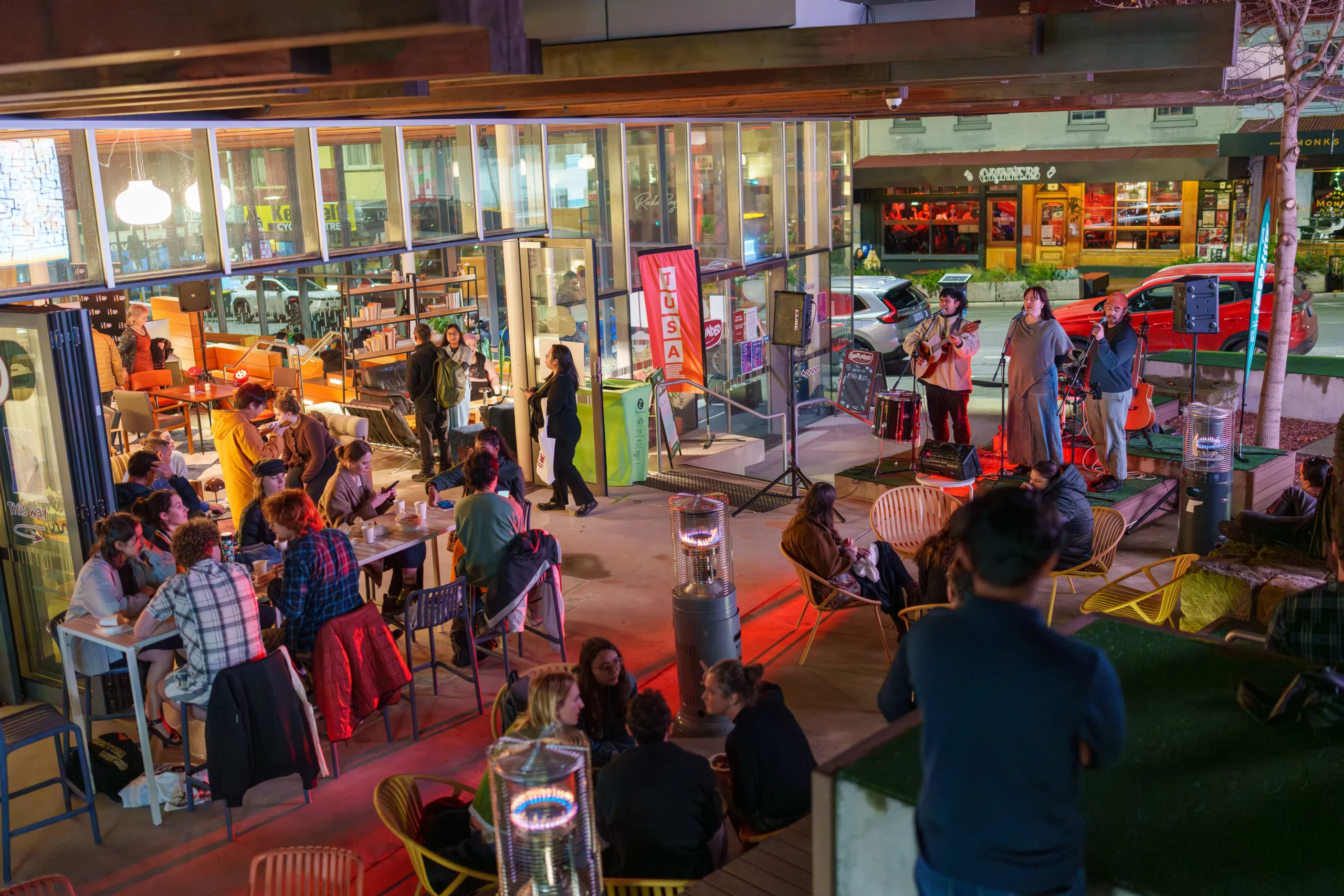
TUSA After Dark, supported by the Visa Vibe Grants program, offered one small alternative with free food and live music at Grounded Cafe. It showed that vibrancy need not be expensive. A meal, music and a room full of people can create connection, belonging and an audience for emerging performers.
Elsewhere, the Committee for Sydney helped build momentum for a whole-of-government approach and the NSW 24-Hour Economy Commissioner. The role provides a focal point across regulation, precincts, live performance, transport, safety and activation. Queensland has since appointed its own Night-Life Economy Commissioner.
NSW has since gone further, legislating reforms to protect live music venues, festivals and events. They include new noise regulation, live venue accreditation, streamlined engagement with government agencies and specific support for all-ages gigs. This looks beyond individual grants to structural barriers that determine whether live music can thrive.
The Committee for Brisbane has extended this thinking by championing the dawn economy and recognising that a city’s economic and social life neither begins at nine in the morning nor finishes at midnight.
A vibrant place has different rhythms: early swimmers and gym-goers; cafés opening; essential workers changing shifts; then restaurants, galleries, theatres, gigs and late-night food. A 24-hour economy is not just about staying out later, but making the city work better across the full day.
Greater Hobart can learn from these examples, but copying Melbourne, Sydney or Brisbane would miss the point. Our opportunity is to make the idea distinctly ours.
We already have extraordinary ingredients: the Hedberg and the Conservatorium, MONA, MAC, Frying Pan Studios, The Hanging Garden, the Odeon, the Tasmanian Symphony Orchestra, festivals, venues and an exceptional creative community.
Imagine deliberately building Hobart as a sanctuary of sound and creativity: a small city at the edge of the world where people come to compose, record, perform, collaborate and experiment. In a connected world, our distance could become part of the proposition.
This connects directly to our renewal agenda. Density done well is not simply more housing; it creates places where people live near jobs, services and transport, supported by public space, hospitality, culture and music. Renewal creates critical mass for local businesses, venues and creative activity. Density without activation and connection misses the opportunity.
Creativity, culture and inclusion should be treated as infrastructure requiring long-term investment, not short-term grants. Alongside affordable rehearsal and performance spaces, all-ages venues, transport and great public places, we need enduring ways to fund the people and organisations that bring them to life.
Music Australia’s latest Bass Line research shows artist income is just $14,800. Almost half of artist earnings came from live performance, while incomes grew by less than one per cent during the year.
At Friday night’s amazing Cat Empire concert with the Tasmanian Symphony Orchestra, Felix Riebl put it simply: “Live music needs a live audience.” Building one means affordable participation, access for young people, and places where performers and audiences can discover one another.
Greater Hobart should explore approaches that combine philanthropy, business, government and community capital to create enduring funding. We need financial architecture that supports creativity, culture and inclusion beyond political cycles.
The rankings are useful benchmarks, but they should not define our ambition. We can build a distinctly Greater Hobart 24-hour economy that is affordable, creative, safe and inclusive, where food, music, public space and community come together from dawn until well after dark.
A sanctuary of sound and creativity at the bottom of the world sounds much more like us.
Also published in The Mercury, Tuesday September 8, 2026.