
They tell us something about what we value, how we see our future, and whether we are prepared to invest in learning, research and connection at a time when the world feels increasingly uncertain.
Tasmanian University Student Association (TUSA) President Jack Oates Pryor’s recent op-ed in The Mercury, More Than a Building, was an excellent contribution to this conversation. It rightly centres the experience of students and staff and reminds us that the success of places like the Forest will not be judged by architecture alone, but by whether they foster genuine connection, belonging and opportunity.
Because infrastructure on its own does not create community.
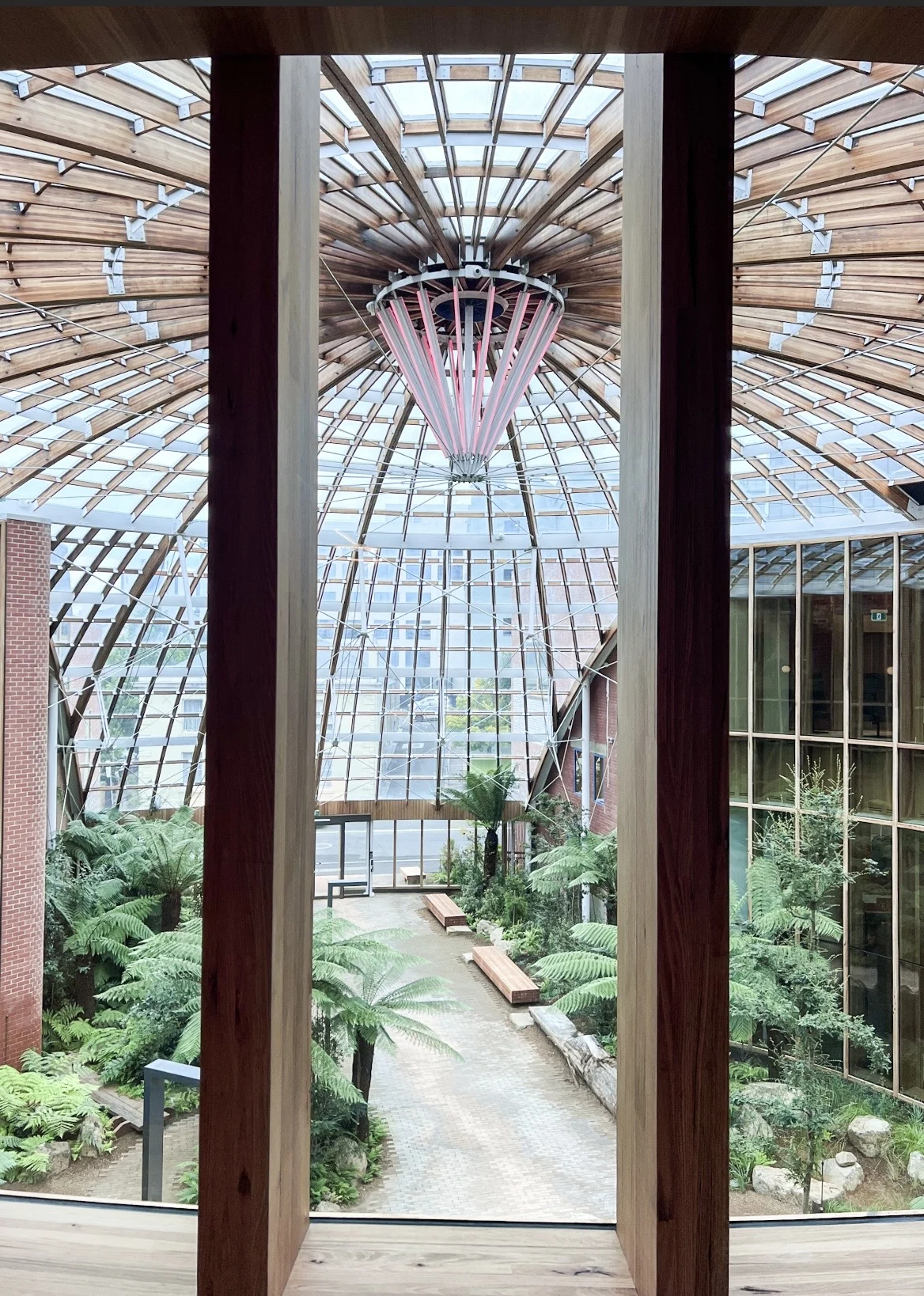
Since the building opened, I’ve spent a fair bit of time in the Forest. Walking through it, meeting people, sitting in on conversations. You can feel something happening already. There’s a hum to the place. Students and staff moving through the spaces, groups gathering, community meetings spilling into shared areas, people bumping into each other and conversations starting up.
At one point, I was trying to do some work between meetings while also being hassled by my own kids for money. Which, in its own way, probably says everything. These are places where life happens. Not just learning, but all the messy, human stuff that sits around it.
That is what we should be aiming for.
Because in moments like this it can be tempting to narrow our focus to short-term pressures, but resilient communities do something different. They invest in the long-term foundations of prosperity and wellbeing, and education is one of those foundations.
The Forest is a significant step in strengthening the role of learning, research and innovation in Greater Hobart. It reflects a university evolving alongside the communities it serves. But as Jack points out, the real work now is what happens next: how these spaces are used, who feels welcome in them, and whether students feel connected, not just present.
If we are honest, this is an area where we still have work to do. Hobart is often described as friendly but not always quickly welcoming. For students arriving from interstate, overseas or regional Tasmania, that gap matters. It shapes whether people stay, whether they build lives here, and whether they see a future in this place.
This is not just a Hobart conversation either.
In recent discussions with colleagues from Committees for Capital Cities across the country, a clear pattern is emerging. Universities are investing heavily in central, connected, high-quality spaces that bring students and staff closer to the life of the city.
In Brisbane, Queensland University of Technology and the University of Queensland continue to invest in major inner-city precincts, while Griffith University is transforming the former Treasury building into a new CBD campus.
In Sydney, UTS continues to reshape Ultimo with contemporary learning environments embedded in the city. In Adelaide, structural change is opening up new thinking about connected, city-based precincts. In Western Australia, similar shifts are creating opportunities to reimagine learning and research in the heart of Perth.
The direction is clear. Universities are moving deeper into communities, not away from them.
And we cannot afford to be left behind.
These are not just buildings. They are long-term investments in capability, productivity and opportunity. They shape whether people come, whether they stay, and whether they see a future in a place.
Which brings us back to Hobart. The Forest is a major investment, but it also raises a bigger question: what do we want this moment to become?
Because the opportunity is not just the building itself. It is everything around it. How it connects to the city. How it is used throughout the day. How it links with other parts of the university. How we think about the broader footprint of learning and research across Greater Hobart over time.
At the Committee, we often talk about renewal and vibrancy.
Renewal is about more than development. It is about creating places that work, that people want to spend time in, and that offer opportunity. It is about thinking ahead. What will Greater Hobart look like when our kids are grandparents?
Vibrancy is not cosmetic. It is economic. It is what happens when people from different backgrounds and disciplines come together, when ideas are shared and built on.
When learning environments are embedded in connected places, you start to see what we have described as flow. The ease with which people move between education, work, creativity and community life. That is where productivity and opportunity begin to build.
We should also be clear about the economic context. Tasmania has one of the oldest populations in the country. We are competing for talent. Students will only stay if they feel connected, if they can see pathways into careers, and if they can imagine a life here.
That is why universities matter so much.
Through our work at the Committee, we have convened conversations on the role of education, and particularly STEM, in shaping Tasmania’s future. The message has been consistent. If we are serious about lifting productivity and creating long-term prosperity, we need to double down on capability in science, technology, engineering and mathematics.
This is where future industries will emerge, where new jobs will be created, and where we build the foundations for economic development, innovation and resilience.
But this does not happen in the abstract. It needs to be underpinned by contemporary, high-quality learning environments and research infrastructure. Places that signal to talent, both here and from around the world, that this is a community that values knowledge, backs innovation and is serious about its future.
When IMAS opened, a friend of mine in the UK mentioned that his son, undertaking postdoctoral research at Oxford in Antarctic and marine climate science, saw Tasmania as the place he wanted to be. His ambition was simple. He wanted to come here and work at IMAS.
That is the power of getting this right.
These investments do more than support local students. They send a signal globally. They tell people that this is a place where serious work is happening, where opportunity exists, and where you can build a career and a life.
Investments like this invite us to see both the forest and the trees, recognising the immediate benefits of new learning spaces while understanding the deeper ecosystems of knowledge, innovation and connection they help grow.
For councils, business, educators, government and community organisations alike, this is a moment to step up. To build partnerships, activate these spaces and help grow the ecosystem around learning, creativity and innovation.
If we embrace this moment, the benefits will extend far beyond a single building, helping shape a Tasmania where opportunity grows across generations and where people can imagine their futures here with confidence.
Cam Crawford is Chief Executive of the Committee for Greater Hobart