
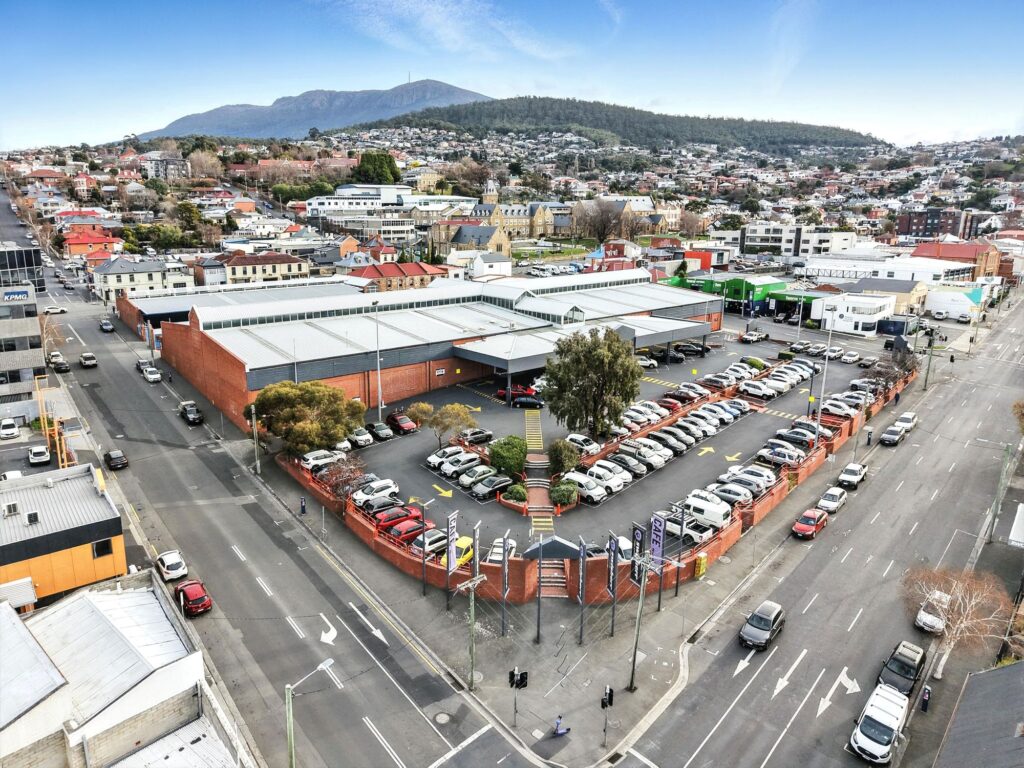
the future of the former K&D site in central Hobart as a unique and generational opportunity — one that demands bold vision, coordination, and leadership.
Strategically located near the heart of the CBD, and in close proximity to schools, public transport, health services, and other vital community infrastructure, the K&D site is ideally placed to become a catalyst for an exemplar development.
It has the potential to showcase how Hobart can deliver housing activation, vibrant community spaces, and a liveable, inclusive urban environment.
To achieve this, we must put the voices of young people and our multicultural communities at the centre of decision-making — those who will live with the outcomes of these decisions for generations.
The University of Tasmania’s significant investment in the city’s mid-town precinct — including the redevelopment of the former Forestry Tasmania building and the delivery of new accommodation and learning facilities – further strengthens the case for a coherent and coordinated approach to precinct-scale urban renewal in this area.
The scale of this transformation highlights the long-term need — and opportunity — to ensure surrounding sites such as the K&D property are not considered in isolation, but as part of a broader, integrated vision for central Hobart. We should look to the lessons of projects like Bowden in South Australia or the many innovative developments delivered by Nightingale Housing — projects that exemplify how great design, sustainability, affordability, and community outcomes can go together. Crucially, these projects succeeded because they were enabled by delivery-focused coordination and purpose-built governance mechanisms.
We recognise that bringing such a project to life involves tackling the full spectrum of the development cost stack — from enabling infrastructure (water, sewer, stormwater, electricity), through to planning certainty, financing models, and construction costs. This is where the Renewal SA model, working together with the South Australian Housing Trust, has been particularly effective. Through aligned governance, public investment, and a shared commitment to long-term public value, they’ve been able to unlock precinct-scale developments that otherwise would have stalled.
To succeed, we must also be able to unlock private capital and be a credible counterpart to the Australian Government to leverage national investment and policy frameworks.
This is the kind of coordinated future-focused approach we need here in Greater Hobart. Our current systems, processes and fragmented governance arrangements are not fit-for-purpose to deliver the scale and quality of urban renewal our growing population and housing challenges demand.
The Committee for Greater Hobart has long advocated for both governance reform and exemplar infill projects that can demonstrate what’s possible when governments, the community, and the private sector work together. Sites like St John’s Park in New Town, the Argyle and Campbell Street blocks, and the Hobart to Glenorchy urban corridor have been identified for years as significant urban renewal opportunities. Yet progress remains stalled.
The need to activate these sites — and to do so in a way that is collaborative, well-governed, and visionary — is consistent with the outcomes of the Housing Forum convened by the City of Hobart in 2024, which identified the importance of strategic infill, intergovernmental cooperation, and shared investment.
We cannot afford to miss this moment. The K&D site provides an opportunity not only to deliver much-needed housing and community infrastructure, but also to reimagine how we approach urban renewal and development more broadly. If we fail to act now — with vision, commitment, and collaboration — we risk yet another lost decade of unrealised potential.
Cam Crawford is Chief Executive of the Committee for Greater Hobart
The above message was sent to leaders across government and City of Hobart as part of our ongoing stakeholder engagement about the future liveability of Greater Hobart.